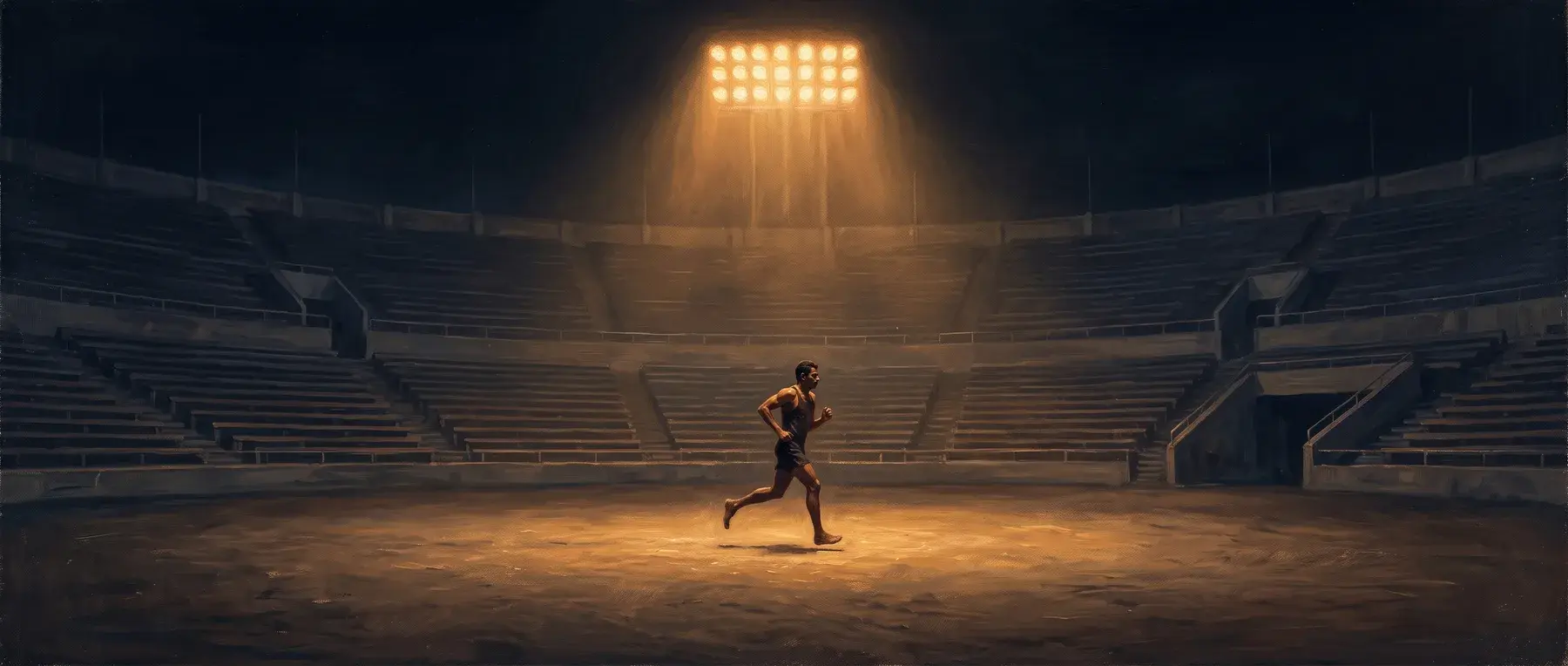
The Absence of Glory
The absence of glory turns out to be a kind of sovereignty nobody can take from you.
I've been watching a lot of sports videos lately — people representing their states, their countries, or just competing for themselves. The FIFA World Cup is underway, and you see athletes doing everything they can to win.
For a second, it led me to a hypothesis: that physical and mental fortitude are two different things — the former being easier than the latter.
After all — when you train your body, the feedback is fast and quantified. You lift and the number goes up. You run and your endurance picks up. There's a defined arena in time, a clear opponent, a scoreboard — and if you're playing nationally or internationally, a crowd doing part of your motivational work for you.
Compare that to being in tech — prepping for interviews, or studying for an exam. The loop is slow, sparse, ambiguous, and unwitnessed. You can grind for three months and see nothing. You do the LeetCode, you sit the interviews, and then they ask something you never prepared for and you're lost.
But when I sat down to challenge that hypothesis, it led me somewhere better.
Physical and mental fortitude are mostly the same muscle — what differs is the environment the muscle runs in.
Talk to anyone who's done hard training and they'll tell you the body quits long before it's empty. The marathoner at mile 20, the boxer in the eleventh round, the guy on his last set — none of them are stopped by muscle. They're stopped by the mind's negotiation with discomfort. Elite physical performance is almost entirely a mental event.
The difference is just the environment. For the athlete, it's a tight, fast, quantified loop — and one that gets witnessed. For us, the compounding stays invisible until, suddenly, it isn't. The opponent is diffuse — the market, the problem, my own attention. And there's nobody in the stands. Not even me — until you learn to be, through journaling and gratitude.
And those videos I was watching? Ten edited minutes of the people for whom the training paid off. Survivorship bias in its purest form.
What about the thousands who didn't make it? Looking back on my own years as an athlete, I remember so many who trained just as brutally — and then got injured, or buried under family responsibilities, or talked into "stop being a kid, studies will only take you far, sports is waste of time, yada yada..." until they gave up the sport and never saw a stadium. Their anguish was just as real, and even less witnessed.
So the input — these videos — romanticises physical discipline by only ever showing the payoff arc. But real sport is also mostly glory-less grinding by people who never make it.
Which brings me to the real question: how do we leverage this one feature of our path — the absence of glory?
The athlete's pain is acute but bounded. The match ends. There's an off-season. You win, and you celebrate. Ours is chronic and unbounded — there's no final whistle on a career, on learning, on building a company. Open-ended uncertainty with no defined end is one of the most corrosive things a human can endure — harder, in a real sense, than intense pain you know will stop in ninety minutes.
So if the battle feels heavier — we're probably not imagining it.
Nishkama Karma
But here's the turn. We've been placed where the fruit is delayed, invisible, or uncertain — and that forces the harder, more mature posture. You have to make full effort with zero attachment to the result, because there's no result in front of you to attach to in the first place.
Karmanye vadhikaraste ma phaleshu kadachana
The glory-less path is the more dharmically demanding one, precisely because it strips away the scoreboard and asks you to act rightly anyway. By that logic, the stadium is almost a crutch — it lets the athlete borrow meaning from the crowd instead of generating it from within.
The absence of a stadium is a form of sovereignty. The athlete's meaning is rented from the crowd, and it expires when the season ends. Ours is self-authored — it doesn't depend on anyone watching. Lonelier, yes. But it's also the only kind of fortitude that nobody can take from me.